
By the Find Insurance Canada editorial team · Published September 24, 2026 · Last updated September 24, 2026
At a glance
- Average home insurance cost: $1,526 a year for owner households, about $127 a month (Statistics Canada, 2023).
- With or without a mortgage: $1,595 with a mortgage, $1,436 without one.
- Rising, in numbers: the home insurance price index rose 13.2% from 2023 to 2025, against 4.5% for everything else.
- Biggest increase: Alberta, up 22.0% in two years. Smallest: Prince Edward Island, up 2.2%.
- Tenants: $295 a year on average per renter household.
The average home insurance cost in Canada was $1,526 a year for households that own their home, or about $127 a month, according to Statistics Canada’s 2023 household spending survey. Prices have climbed since: the home insurance price index rose 13.2% between 2023 and 2025, which puts a typical owner at about $1,730 a year today.
- What is the average home insurance cost in Canada?
- What will home insurance cost in 2026?
- Home insurance cost estimator
- How much has home insurance cost risen in your province?
- What drives home insurance cost in each province?
- Why is home insurance getting more expensive?
- What changes your home insurance cost?
- What does your home insurance cost pay for?
- What do you need to get an accurate home insurance quote?
- Why do home insurance cost averages online disagree?
- How much do tenant and condo insurance cost?
- How can you lower your home insurance cost?
- Should you pay your home insurance cost monthly or yearly?
- Home insurance cost FAQ
What is the average home insurance cost in Canada?
Canadian homeowners spent an average of $1,526 on home insurance in 2023, the latest year Statistics Canada has published.
That figure comes from the Survey of Household Spending, by household tenure, which asks thousands of households what they actually paid. It is a real spending figure, not a quote estimate, which is why we use it as our starting point.
| Household (2023) | Average per year | About per month |
|---|---|---|
| All owner households | $1,526 | $127 |
| Owners with a mortgage | $1,595 | $133 |
| Owners without a mortgage | $1,436 | $120 |
| Renter households (tenant insurance) | $295 | $25 |
Source: Statistics Canada, table 11-10-0225-01. Monthly amounts are the yearly average divided by 12.
Owners with a mortgage pay about $159 a year more than owners without one. Lenders require coverage for the full rebuild cost and set rules on the deductible, while owners without a mortgage are free to choose their own limits.
The average has almost doubled since 2010. Across all Canadian households, spending on home insurance went from $541 in 2010 to $848 in 2019 and $1,018 in 2023.
What will home insurance cost in 2026?
If premiums moved with Statistics Canada’s price index, an owner who paid the $1,526 average in 2023 would pay about $1,730 a year by 2025.
Statistics Canada tracks home insurance prices in its Consumer Price Index under “homeowners’ home and mortgage insurance”. We applied that index to the 2023 spending average to estimate the next two years. This is our math, not a published average:
| Year | Index (Canada) | Estimated yearly home insurance cost |
|---|---|---|
| 2023 | 318.3 | $1,526 (actual survey average) |
| 2024 | 342.9 | about $1,644 |
| 2025 | 360.3 | about $1,727 |
The 2026 annual index is not out yet. The index rose 7.7% in 2024 and 5.1% in 2025, so expect your 2026 renewal to come in higher than last year unless you change your coverage or your insurer.
Home insurance cost estimator
Enter what you paid for a year of home insurance, the year you paid it and your province. The estimator applies your province’s Statistics Canada price change to show what the same coverage would cost at 2025 prices. No amount handy? Use one of the national averages.
Use a national average (2023):
How it works: your amount times the change in Statistics Canada’s “homeowners’ home and mortgage insurance” price index for your province, from the year you paid to 2025 (table 18-10-0005-01). The territories are not published separately, so they use the national index. This is an estimate of price change only. Your renewal also depends on your home, your claims and your insurer.

How much has home insurance cost risen in your province?
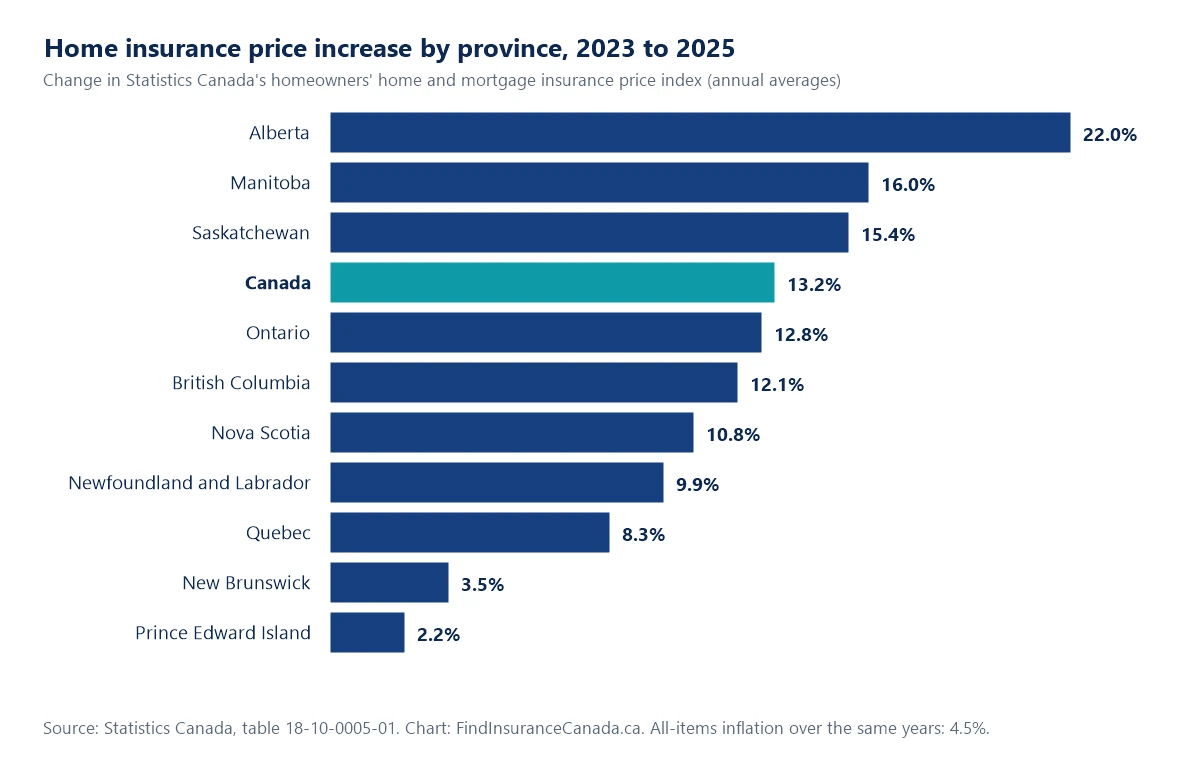
From 2023 to 2025, home insurance prices rose fastest in Alberta (22.0%) and slowest in Prince Edward Island (2.2%).
| Province | Price change 2023 to 2025 | Price change 2019 to 2025 |
|---|---|---|
| Newfoundland and Labrador | 9.9% | 19.8% |
| Prince Edward Island | 2.2% | 26.7% |
| Nova Scotia | 10.8% | 44.2% |
| New Brunswick | 3.5% | 34.1% |
| Quebec | 8.3% | 35.0% |
| Ontario | 12.8% | 44.1% |
| Manitoba | 16.0% | 43.6% |
| Saskatchewan | 15.4% | 44.2% |
| Alberta | 22.0% | 61.8% |
| British Columbia | 12.1% | 50.7% |
| Canada | 13.2% | 45.2% |
Source: Statistics Canada, table 18-10-0005-01, “homeowners’ home and mortgage insurance” index, annual averages. Over the same 2019 to 2025 period, prices for everything Canadians buy rose 20.7%.
The index measures price changes, not price levels. It tells you how much faster home insurance got more expensive in Alberta than in Quebec, not what a policy costs in each province. For your actual price, you need a quote on your own home.
What drives home insurance cost in each province?
Each region’s home insurance cost follows its own weather: hail on the Prairies, ice and water in central Canada, winter storms in the Atlantic provinces and floods in British Columbia.
Alberta
Alberta had the largest increase in Canada, 22.0% from 2023 to 2025, and 10.6% in 2025 alone. Hail is the main driver. A hailstorm hit Calgary in July 2025, and storms on August 20 and 21, 2025 caused over $235 million in insured damage across three provinces, with Alberta taking the largest share, according to the Insurance Bureau of Canada.
Manitoba and Saskatchewan
Prices rose 16.0% in Manitoba and 15.4% in Saskatchewan over the same two years. Wildfire has joined hail as a Prairie risk: fires reached Flin Flon, Manitoba, and La Ronge, Saskatchewan, in May 2025, two of the year’s notable events on the Insurance Bureau of Canada’s list.
Ontario and Quebec
Prices rose 12.8% in Ontario and 8.3% in Quebec. The late March 2025 ice storm caused an estimated $466 million in insured damage in Ontario and Quebec. A month earlier, February 2025 storms and a thaw across Ontario, Quebec and Atlantic Canada caused over $260 million, and ice damming and basement leaks were the leading causes of claims. If you have a finished basement, sewer backup coverage matters most here.
British Columbia
Prices rose 12.1% in British Columbia from 2023 to 2025 and 50.7% since 2019, the second largest six year rise after Alberta. December 2025 floods were among the year’s notable events. Earthquake coverage is not part of a standard home policy anywhere in Canada; in British Columbia it is an add on worth pricing separately.
Atlantic Canada
Increases were smaller in the east: 10.8% in Nova Scotia, 9.9% in Newfoundland and Labrador, 3.5% in New Brunswick and 2.2% in Prince Edward Island, the smallest in the country. Winter storms still drive claims here, including the February 2025 storm that added to the $260 million total above.
Why is home insurance getting more expensive?
Home insurance costs more because weather claims have grown and homes cost more to rebuild.
- Record weather losses: severe weather caused a record $8.5 billion in insured damage in 2024, the costliest year in Canadian history, according to the Insurance Bureau of Canada. The total for 2025 exceeded $2.4 billion.
- A long rise, not one bad year: since 2009, insurers have paid nearly $2 billion a year on average for catastrophic weather claims, up from about $400 million a year between 1983 and 2008, as the Insurance Bureau of Canada notes from a 2026 Statistics Canada report.
- Rebuilding costs more: your premium is based on what it would cost to rebuild your home, not its market value. When labour and materials go up, so does the amount insurers must cover.
- Water risk is priced separately: many insurers sell sewer backup and overland water coverage as add ons, priced to the flood risk where you live.

What changes your home insurance cost?
Your price depends mostly on what it would cost to rebuild your home, where it is, and your claims history.

- Rebuild cost: the size of the home, how it is built and its finishes. A larger home with custom finishes costs more to insure.
- Location: distance to a fire hydrant and fire hall, flood and hail risk in your area, and local crime.
- Age and condition: the age of the roof and of the heating, plumbing and wiring. Old galvanized pipes or an aging roof can raise the price or limit coverage.
- Claims history: recent claims on your policy, and sometimes on the property itself, usually raise the premium.
- Coverage type: a comprehensive policy covers every risk not excluded; a named perils policy covers only the risks it lists and costs less.
- Add ons: sewer backup, overland water and earthquake coverage each add to the price.
- Deductible: the amount you pay on each claim. A higher deductible means a lower premium.
- Home business or rental suite: both change the risk and must be declared, or a claim can be refused.
What does your home insurance cost pay for?
A standard home policy pays for five things: the building, other structures, your belongings, extra living costs after a claim and your liability to other people.
| Coverage | What it pays for |
|---|---|
| Dwelling | Repairing or rebuilding the house itself after an insured loss such as fire or wind. |
| Detached structures | A detached garage, shed or fence on your property. |
| Contents | Your furniture, clothing, electronics and other belongings, usually with lower limits for jewellery, bikes and cash. |
| Additional living expenses | Hotel, meals and other extra costs while your home cannot be lived in after a claim. |
| Personal liability | Claims against you if someone is hurt on your property or you accidentally damage someone else’s property. |
Three policy types set how wide that protection is. A comprehensive policy covers every risk except those it excludes and costs the most. A broad policy covers the building on a comprehensive basis and your belongings only for listed risks. A basic or named perils policy covers only the risks it lists and costs the least. When you compare prices, compare the same policy type.
Standard policies usually exclude gradual damage, wear and tear, pests, and flooding from outside unless you add overland water coverage. Read the exclusions page of any quote before you decide it is cheaper.
What do you need to get an accurate home insurance quote?
An accurate quote needs the facts an insurer uses to price your home, so have them ready before you ask.
- The home: year built, square footage, number of storeys, construction type and whether the basement is finished.
- The systems: the age of the roof and the type and age of the heating, plumbing and electrical systems, with the years of any updates.
- Protection: smoke detectors, a monitored alarm, a sump pump or backwater valve, and the distance to the nearest fire hydrant.
- Your history: claims in the last 5 years and any policy that was cancelled.
- Your current policy: its limits, deductible and add ons, so every new quote prices the same coverage.
A quote built on guesses can change after a claim or an inspection. Correct details up front give you a price you can rely on.
Why do home insurance cost averages online disagree?
Different websites measure different things, so a $1,300 average and a $2,500 average can both be “right”.
Quote comparison sites usually report the average of quotes their own visitors received, for the coverage those visitors chose. Some insurers publish figures for a sample home. Statistics Canada reports what households actually spent across the whole year. We lead with the Statistics Canada figure because it is the only one based on what Canadians really paid, and we show you how we updated it. Treat any single average as a rough guide, then compare real quotes for your own home.
How much do tenant and condo insurance cost?
Renter households spent an average of $295 on tenant insurance in 2023, according to Statistics Canada, far less than a homeowner’s home insurance cost because a tenant policy does not cover the building.
That $295 includes renters who bought no policy at all, so a renter who does buy tenant insurance pays more than that on average. Some landlords require it in the lease.

| Coverage | Tenant policy | Condo unit owner policy |
|---|---|---|
| Your belongings | Yes | Yes |
| Personal liability | Yes | Yes |
| Extra living costs after a claim | Yes | Yes |
| Upgrades to the unit (floors, kitchen, bathrooms added after the original build) | Only improvements you made as a tenant, if listed | Yes, often called improvements and betterments |
| Your share of a building claim (loss assessment) | No | Yes |
| The building itself | No, the landlord insures it | No, the condo corporation insures it |
Condo insurance fills the gaps in the condo corporation’s building policy. Two numbers decide how much you need: the value of upgrades made to your unit since it was built, and the corporation’s insurance deductible. Many corporations can charge that deductible back to the owner whose unit caused the loss, so check the declaration and bylaws, then set your loss assessment limit at least that high. Statistics Canada does not publish a separate condo figure, so get quotes using those two numbers.
How can you lower your home insurance cost?
The biggest savings come from comparing the same coverage across insurers and choosing your deductible carefully.

- Compare at every renewal: ask two or three insurers to quote the same limits, deductible and add ons. Insurers weigh risks differently, so the same home can get very different prices.
- Raise your deductible: going from a low deductible to a higher one usually cuts the premium. Pick an amount you could pay tomorrow.
- Bundle home and auto: most insurers give a discount when both policies are with them.
- Stay claims free: small claims can cost more in higher premiums than they pay out. Many owners pay minor repairs themselves.
- Upgrade what insurers price: a newer roof, updated wiring or plumbing, a backwater valve or sump pump, and monitored alarms can all lower the price. Tell your insurer when you make one.
- Review your add ons: keep the ones that match your risk, such as sewer backup if you have a finished basement, and drop the ones you do not need.
- Ask about discounts: mortgage free, new home, retiree, claims free and loyalty discounts all exist, and not every insurer offers the same ones.
Before you switch, check the new policy covers the same things as the old one. A cheaper quote that drops water coverage is not a saving.
Should you pay your home insurance cost monthly or yearly?
Paying the full year up front is often the cheaper way to cover your home insurance cost, because some insurers add a fee or interest to monthly payments.
Ask each insurer two questions before you choose: is there a charge for monthly billing, and is there a discount for paying the year in full? If monthly payments cost nothing extra, spreading the bill over 12 months can make budgeting easier. If they do cost extra, that charge is part of your home insurance cost, so include it when you compare quotes. Also check the renewal date and set a reminder about 30 days before it, which gives you time to shop around instead of accepting an automatic increase.
Is home insurance required in Canada?
No Canadian law requires home insurance, but almost every mortgage lender does.
Your lender will ask for proof of coverage before closing and will be named on the policy. Once your mortgage is paid off, insurance is your choice. Most owners keep it, because a single fire, flood or liability claim can cost far more than years of premiums.
Home insurance cost FAQ
What is the average home insurance cost in Canada?
Owner households spent an average of $1,526 on home insurance in 2023, according to Statistics Canada. The home insurance price index rose 13.2% from 2023 to 2025, so if premiums moved with it, the same household would pay about $1,730 a year in 2025.
How much is home insurance per month in Canada?
About $127 a month in 2023 for the average owner household ($1,526 divided by 12). If premiums followed the price index, that became about $144 a month in 2025. Your own price can sit well above or below that.
Why did my home insurance cost go up this year?
The two big reasons are weather claims and rebuilding costs. Insurers paid a record $8.5 billion in severe weather claims in 2024, and it costs more to rebuild a home than it did five years ago. Statistics Canada’s home insurance index rose 5.1% in 2025 alone.
Which province had the biggest home insurance increase?
Alberta. Its home insurance price index rose 22.0% from 2023 to 2025 and 10.6% in 2025 alone. Prince Edward Island had the smallest increase over the same two years, at 2.2%.
Is home insurance mandatory in Canada?
No law requires it, but almost every mortgage lender does, and it must name the lender. If your home is paid off, it is your choice, although one uninsured fire or flood can cost far more than decades of premiums.
How much does tenant insurance cost in Canada?
Renter households spent an average of $295 on tenant insurance in 2023, according to Statistics Canada. That average includes renters who bought no policy at all, so renters who do buy one pay more than $295 on average.
Does a higher deductible lower my home insurance cost?
Usually, yes. When you agree to pay more of each claim yourself, the insurer charges a lower premium. Only choose a deductible you could pay tomorrow without borrowing.
The Find Insurance Canada editorial team writes and updates the guides on this site. We explain life, health, dental, home, auto and critical illness insurance for Canadians in plain language and check every number against federal and provincial sources. How we write and check our guides
Sources: Statistics Canada tables 11-10-0225-01 and 11-10-0222-01 (household spending, 2023) and 18-10-0005-01 (Consumer Price Index, annual averages to 2025); Insurance Bureau of Canada releases dated January 20, 2026 and June 17, 2026. All checked on September 24, 2026. This guide is general information, not insurance advice. Find Insurance Canada is not an insurer, agent or broker; quotes come from licensed representatives through our referral partner, which may pay us a fee. How this site works and is paid